
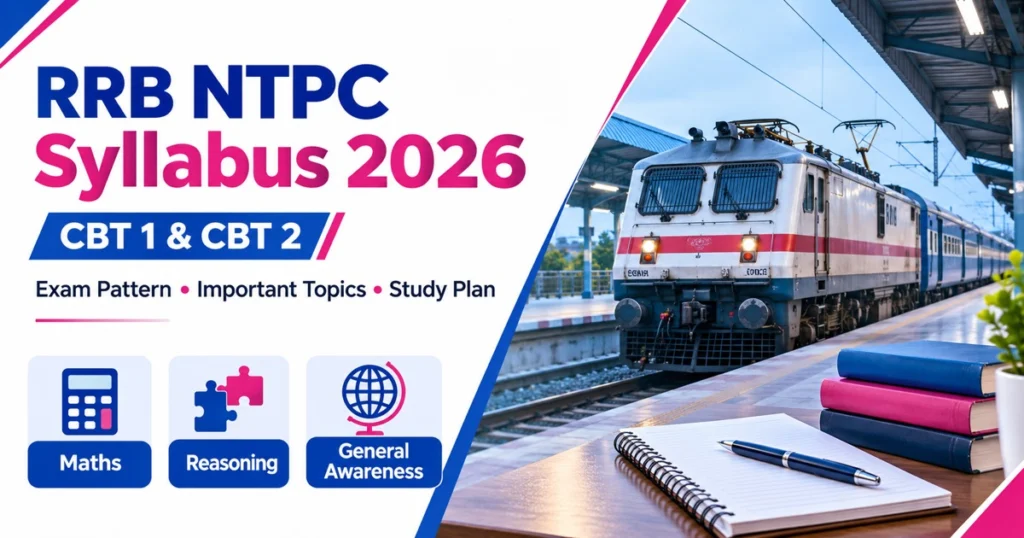
The RRB NTPC Syllabus 2026 helps students organise preparation for the railway Non-Technical Popular Categories examinations. It covers Mathematics, General Intelligence and Reasoning, and General Awareness. Maths preparation includes arithmetic and basic geometry; Reasoning involves patterns, relationships and logical questions; General Awareness combines current events with science, history, geography, polity and other general knowledge topics.
The CBT pattern explained below has 100 questions in CBT 1 and 120 in CBT 2, with a standard duration of 90 minutes for each. Students therefore need subject knowledge, accurate calculations and timed practice. This guide brings together the topic lists, stage-wise pattern, previous-paper practice and a six-week study plan to help you decide what to study and how to revise.
Source note: the pattern and topic baseline below were checked against the accessible official CEN 06/2025. The CEN 06/2026 document could not be retrieved during this review. Confirm your own CEN and any corrections through the official RRB website before treating the baseline as your final examination instructions.
RRB NTPC Exam Pattern 2026: CBT 1 and CBT 2 comparison
The table summarises the established pattern in official CEN 06/2025, section 13. Each question carries one mark. Subject allocations are indicative and may vary in actual papers.
| Subject or feature | CBT 1 baseline | CBT 2 baseline |
|---|---|---|
| General Awareness | 40 questions | 50 questions |
| Mathematics | 30 questions | 35 questions |
| Reasoning | 30 questions | 35 questions |
| Total questions/marks | 100/100 | 120/120 |
| Standard duration | 90 minutes | 90 minutes |
| Wrong-answer deduction | One-third mark | One-third mark |
The cited notice provides 120 minutes for candidates eligible to use a scribe. Check the applicable provisions for your recruitment. The practical difference between stages is pace: with more questions in the same standard duration, CBT 2 needs stronger recall and quicker decisions.
Keep recruitment eligibility separate from the syllabus. Our RRB NTPC Graduate Recruitment 2026 guide explains the application context; this article focuses on study preparation.
RRB NTPC Maths Syllabus: what to study first
The Mathematics baseline covers number system, decimals, fractions, LCM/HCF, ratio, percentage, mensuration, work and time, speed and distance, interest, profit/loss, elementary algebra, geometry, trigonometry and statistics.
Begin with fractions, percentages and ratios if your basics are weak. These ideas support several arithmetic chapters. For example, understanding percentage change helps with discounts, interest and profit calculations. Study the method, solve examples slowly, then try a short timed set.
Turn formula revision into problem solving
Keep a formula page, but write when each formula applies. For a time-and-work question, identify the amount of work completed per unit of time before calculating. For mensuration, draw the shape and mark the given dimensions. This reduces errors caused by choosing a familiar formula too quickly.
Use our syllabus and examination-pattern resources to organise material. Match every chapter to your notification instead of collecting unrelated advanced topics.
RRB NTPC Reasoning Syllabus: build a repeatable method
Reasoning includes analogy, number/alphabet series, coding-decoding, mathematical operations, similarities, relationships, analytical reasoning, syllogisms, jumbling, Venn diagrams, puzzles, data sufficiency, statements and conclusions, courses of action, decisions, maps and graph interpretation.
Practise one question type until you understand its rules, then mix it with other types. For relationships and directions, use a simple diagram. In a series question, test the relationship between terms rather than guessing from the answer choices.
When a puzzle goes wrong, find the first incorrect placement. Repeating the whole solution without locating that step teaches less. Keep a brief note such as “missed a negative condition” or “assumed an order not stated.”
RRB NTPC General Awareness: organise the broad syllabus
General Awareness brings together current events and static knowledge. The official baseline includes science through Class 10 CBSE level, history, geography, polity, economy, culture, sports, computers, environment, organisations, government programmes and scientific developments.
Divide your notes by subject. Link a current event to its background: a space mission can lead to revision of the responsible organisation and basic science. A programme announcement can prompt questions about its purpose and ministry. Verify current facts through primary sources where available.
Read a small amount daily and revise older notes regularly. A long collection of unread monthly files is not revision. Avoid assuming that a fixed number of current-affairs months guarantees coverage; the cited syllabus gives no such promise.
The railway jobs and examination section helps you distinguish NTPC updates from other railway tests with different requirements.
RRB NTPC CBT 1 Syllabus versus CBT 2 Syllabus
The cited notice lists the same broad subject topics for both stages. This makes it sensible to build one strong foundation, then increase mixed practice. Do not finish CBT 1 preparation and assume every topic must be learned again for CBT 2.
Instead, check whether you can retrieve the method quickly. A chapter may feel familiar while still taking too long under a timer. Revise the slow topics, practise mixed sets and review errors before adding more tests.
RRB NTPC Preparation 2026: an adjustable six-week plan
This is a suggested study schedule, not an official timetable. Extend it if you are starting from basics, and adjust it around your actual examination date.
| Period | Study focus | Review task |
|---|---|---|
| Weeks 1–2 | Arithmetic basics, reasoning rules and science foundations | Identify weak chapters with short topic tests |
| Weeks 3–4 | Remaining syllabus, mixed questions and daily awareness revision | Revisit mistakes before each new set |
| Week 5 | Previous papers and full-duration practice | Separate knowledge gaps from timing problems |
| Week 6 | Mock analysis, formula recall and short-note revision | Check consistency across unfamiliar papers |
For a student with three study hours, a possible split is one hour of Maths, 45 minutes of Reasoning, 45 minutes of General Awareness and 30 minutes of revision. Change the balance when your practice record shows a clear weakness.
Keep important topics tied to your own progress
No chapter list can guarantee the next paper’s questions. Treat the official syllabus as the coverage checklist and your practice record as the priority list. If percentages are weak, give them focused time even when a shared “important topics” list recommends something else.
Before each session, choose a small outcome: solve ratio questions with a clear method, explain a science concept from memory or complete a reasoning set without missing conditions. At the end, check whether you achieved it. This gives revision a purpose beyond counting pages or study hours.
Use RRB NTPC Previous Year Papers and Mock Tests properly
Previous papers show how topics have been asked; they do not predict the next paper. Solve a paper, check the explanation and label each error. Useful labels include concept gap, calculation slip, missed condition and time pressure.
Choose an RRB NTPC Mock Test matching the stage you are preparing for. After finishing, review skipped questions as well as wrong answers. A correct answer that took too long also deserves attention. Retest weak ideas using fresh questions.
Track later admit-card and exam updates for candidate instructions. Use result and qualification notices for official outcomes, rather than interpreting a practice score as selection.
Frequently asked questions
Q. Which subjects should I prepare for RRB NTPC?
Ans. Mathematics, General Intelligence and Reasoning, and General Awareness form the cited official baseline.
Q. Does CBT 2 have a completely different syllabus?
Ans. The cited notice uses the same broad topics, with more questions in CBT 2.
Q. Is there negative marking?
Ans. The verified baseline deducts one-third mark per wrong answer. Confirm your applicable CEN.
Q. Which Maths chapters should beginners start with?
Ans. Fractions, percentages and ratios provide a useful base for arithmetic chapters.
Q. Are previous papers enough?
Ans. Combine them with concept study, fresh practice, mock analysis and revision.
Q. Is this a confirmed new 2026 syllabus?
Ans. This preparation guide uses an official earlier baseline. Verify CEN 06/2026 and subsequent corrections directly with RRB.