
In a bank exam seating arrangement puzzle, a clue can be easy to read and still place the wrong person in the wrong seat. If Ravi sits second to Meera’s left, you start at Meera and count two seats using her facing direction. If you start at Ravi or read left from your own viewpoint, the rest of the diagram can look tidy and still be wrong.
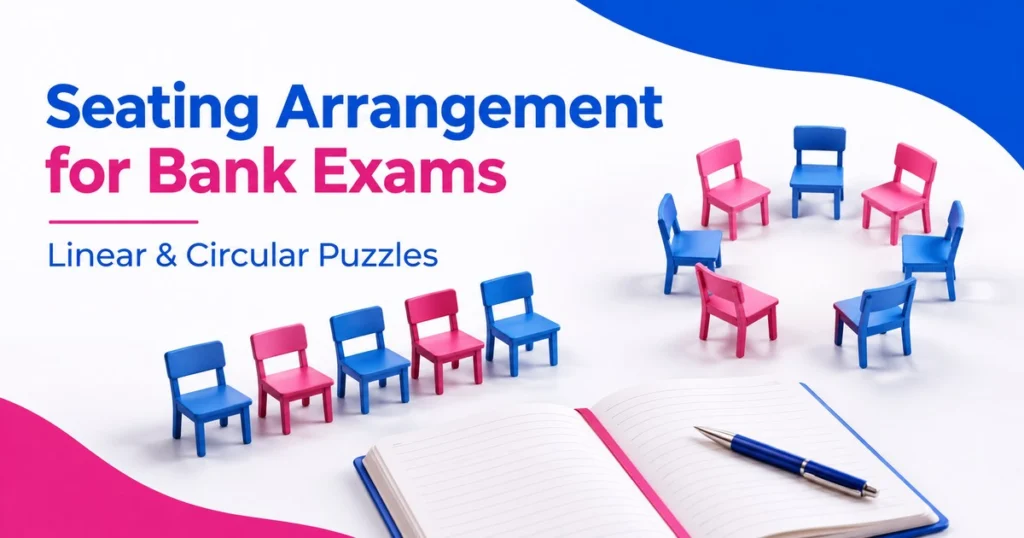
Start with a numbered sketch and build it clue by clue. The two solved examples below show how to place consecutive seats in a row and how to handle clockwise movement in a circle. Use the practice routine at the end to work on whichever step costs you the most time.
Read the setup and place the strongest clue
Mark how many people and seats the question gives you. For a row, write the seat numbers across the page and show which way the people face. For a circle, choose a clockwise numbering direction and mark whether each person faces the centre or outside. If the question includes an empty seat, keep a place for it in your sketch.
Separate fixed information from relative information. “A sits at the left end” fixes a seat when the setup defines that end. “B sits immediately next to C” gives a pair that can still move. Look for a clue that limits the pair’s position before writing either name in a final seat.
When planning practice around a recruitment, use the notice for the specific exam cycle and stage. You can find relevant announcements under banking jobs and recruitment updates.
| Clue wording | What to record |
|---|---|
| Immediately next to | Two adjoining seats |
| Second to the right | Two steps right with one seat between |
| Two people sit between | Three seat steps along the stated row or path |
| At an end | One of the two outer seats in a row |
Linear seating arrangement worked example
Six friends A, B, C, D, E and F sit in one row facing north. A sits at the left end. C sits second to the right of A. B sits immediately to the left of C. E sits immediately to the right of D. F sits at the right end. Who sits immediately to the right of C?
Number the seats 1 to 6 from left to right. Place A in seat 1 and F in seat 6. Count two steps from A to place C in seat 3. B goes in seat 2, directly to the left of C. The open seats are 4 and 5. Since E sits immediately to the right of D, D takes seat 4 and E takes seat 5.
The row reads A, B, C, D, E, F. D sits immediately to C’s right. Check by reading the original clues against this row. The check takes only a few seconds because every name is already in order. Match the difficulty of your practice to the rest of the reasoning topics you’re studying. See the exam syllabus and pattern resources.
Handle a row with mixed facing directions
If some people face south, their right is your left when you draw the row with north at the top of the page. Add a downward arrow for each south-facing person and an upward arrow for each north-facing person. In “P sits immediately to the right of Q,” use Q’s arrow. P’s arrow will matter when another clue uses P as the reference.
Circular seating arrangement worked example
Six people P, Q, R, S, T and U sit around a circular table facing the centre. Q sits immediately to P’s left. R sits opposite P. S sits immediately to R’s right. T sits immediately to R’s left. Who sits opposite S?
Draw six seats and number them clockwise. With everyone facing the centre, a person’s left is clockwise and right is anticlockwise. Choose seat 1 for P because the clues describe positions relative to people. Put Q in seat 2 and R in seat 4, three steps from P. Put S in seat 3 and T in seat 5. U takes the remaining seat, seat 6.
The clockwise order is P, Q, S, R, T, U. U sits opposite S. Start at S in seat 3 and count three seats around the circle to confirm. For a specific IBPS exam, use the relevant notice when choosing a timed set. See IBPS recruitment updates.
Use two sketches when a clue allows two placements
Suppose a pair can occupy either seats 2 and 3 or seats 4 and 5. Draw one light sketch for each placement and apply the next restrictive clue to both. Cross out the sketch as soon as a clue creates a conflict. Keeping the two options visible helps you return to the surviving arrangement without redrawing the whole row.
Practise for accuracy before using a timer
Try one row and one circle on your first day. When checking the answers, write down the first clue you handled incorrectly. If you counted the starting seat as a step, practise short distance clues. If you flipped left and right, draw the facing arrow before doing any placement.
On the second day, solve a few puzzles with mixed facing directions. On the third day, time a short set and record how long you spend building the arrangement. Compare that with the time spent answering the questions. If sketching takes most of the time, try starting with the clue that eliminates the most seats. For exam-specific details, check SBI recruitment updates.
When you redo a puzzle, cover the solution and explain each placement aloud or in writing. “C fits seat 3 because A is in seat 1 and C is two steps to A’s right” gives you a checkable reason. Fit these short sessions around your maths and English practice using the bank exam preparation guide for beginners.
To check your progress, compare two sets of similar length and difficulty. Record the number of correct answers and the time you spent on the initial sketch. If your time falls but accuracy drops, revisit the exact clue that introduced each new error.
Frequently asked questions
Q. How do I start a seating arrangement puzzle?
Ans. Count the seats, mark the facing direction and place a fixed clue such as a person at an end. Use movable blocks for clues that specify relative positions.
Q. What does second to the left mean?
Ans. Move two seats to the left from the named person’s position, using that person’s facing direction. One seat lies between the two people.
Q. Which way is left in a circular seating arrangement?
Ans. For someone facing the centre, left is clockwise. For someone facing outward, left is anticlockwise. Use the facing direction of the person named in the clue.
Q. How can I practise mixed facing questions?
Ans. Draw a small arrow beside each person. Translate each left or right clue using the arrow of its reference person, then verify the relative position on your sketch.
Q. What should I do if two arrangements fit the clues?
Ans. Keep both possibilities while checking the remaining clues. If both survive and give different answers, check whether you missed a constraint or whether the answer choices allow an uncertain result.