
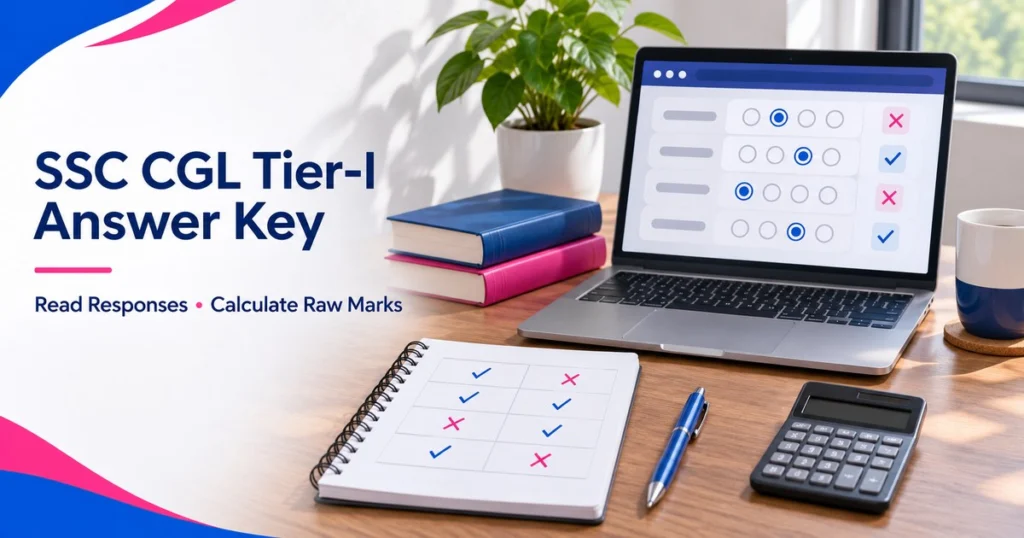
The SSC CGL Tier-I answer key helps you answer two different questions: how many marks your responses appear to earn, and which mistakes deserve attention before your next examination. Mixing those tasks can lead to rushed calculations, unreliable cutoff predictions and hours spent comparing screenshots instead of studying.
This SSC CGL Tier-I answer key guide explains how to read a saved response sheet, estimate raw marks and turn errors into useful preparation. It also clarifies the dated challenge window. It does not promise a live download link, a result date or qualification based on an unofficial score.
First check the notice date and access window
SSC’s official notice dated 4 November 2026 gave a challenge window from 4 November, 9:00 pm, to 7 November, 9:00 pm. That window has passed as of 21 November 2026. The notice also said response sheets and tentative keys would not remain available afterwards. Do not treat an old “link active” headline as proof of access today.
If you saved your response sheet during the window, use that file for personal analysis. If you did not, check subsequent official announcements rather than paying someone who claims to restore access. The official answer key updates page can help you locate notices, but the examining authority’s instructions decide what is available.
The same SSC notice warns that question and option order in the challenge module may differ from the examination display. Match the actual question and recorded response carefully; question number alone is a poor comparison method.
Read the response sheet before counting answers
A response sheet records what you selected. An answer key identifies the answer accepted for evaluation at that stage. A tentative key is subject to the Commission’s review process. Keep those meanings separate when you label your notes.
| Detail | What to check | Common mistake |
|---|---|---|
| Candidate and examination details | Your own exam, date and shift | Using a shared file from another candidate |
| Question content or identifier | The exact item being compared | Matching only its display number |
| Recorded response | The option you actually selected | Replacing it with the answer you remember intending |
| Key status | Tentative or final, with its notice date | Treating a provisional comparison as a final score |
Create three counts: correct, wrong and unanswered. Cross-check their total against the paper. If a question’s status is unclear, mark it separately until you can verify it. Do not quietly include a disputed item in your correct-answer total.
Keep your registration details and saved file private. SSC’s November notice limits the saved question paper to personal use and self-analysis. Avoid posting the complete file or login credentials in public groups.
Calculate SSC CGL Tier-I raw marks step by step
The SSC CGL 2026 examination notice lists four Tier-I subjects with 25 questions and 50 marks each, and a penalty of 0.50 marks per wrong answer. For an ordinary comparison without special question treatment, use:
Estimated raw marks = (correct answers × 2) − (wrong answers × 0.50).
Worked example
Suppose your saved paper shows 72 correct responses, 18 wrong responses and 10 unanswered questions. The counts add up to 100. Correct answers contribute 72 × 2 = 144 marks. Wrong answers subtract 18 × 0.50 = 9 marks. Your estimated raw score is therefore 135 out of 200.
Attempted-question accuracy is a different measure: 72 ÷ 90 × 100 = 80%. It describes accuracy among your 90 attempts, not your percentage of maximum marks. The score percentage is 135 ÷ 200 × 100 = 67.5%. Label both figures so you do not confuse them later.
Use a calculator for checking your analysis at home, then verify the counts manually once. This is a review exercise, not permission to use a calculator inside an examination. If SSC specifies revised treatment for an item, follow that official instruction rather than forcing every item into the simple example.
Why raw marks cannot confirm your result
The examination notice provides for normalization when computer-based examinations run in multiple shifts. Your home calculation is a raw estimate; it is not an official normalized score. Do not add a guessed number of “normalization marks” because someone rated your shift difficult.
A social-media poll also cannot establish the official cutoff. Its participants may be unrepresentative, their figures may use different keys, and some may confuse raw and normalized marks. Record your estimate, acknowledge its limits and continue preparing.
Use the SSC and government exam result updates to find the relevant announcement when available. Read the examination stage, category and list heading before drawing conclusions. Only the official result establishes whether you have been shortlisted at that stage.
Turn the answer review into a short repair list
Give each wrong response a reason: concept gap, calculation slip, misunderstood wording or unsupported guess. Then select a repair that addresses that reason. Watching a full chapter again will not necessarily fix repeatedly overlooking the word “incorrect.”
For example, if six Quant errors involve formulas you could not recall, revise those formulas with fresh questions. If six involve signs or units, practise writing intermediate steps. In English, distinguish a vocabulary gap from choosing an option that sounds familiar but contradicts the passage.
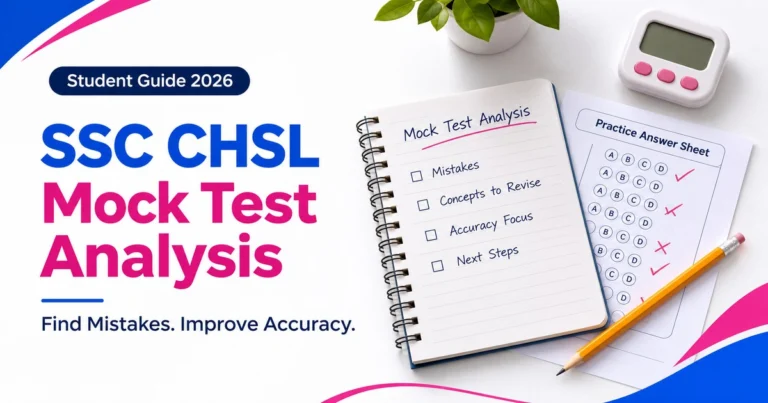
Our existing SSC CHSL mock-test analysis guide offers a useful error-review approach. Apply the review method to CGL while retaining CGL’s own syllabus and marking rules.
Choose three repair tasks for your next study sessions. Make them specific, such as “solve ten percentage questions and check units,” rather than “improve Maths.” Reattempt the original mistakes after a gap, then check whether you can solve unfamiliar questions testing the same idea.
Separate questions you left because you lacked knowledge from questions you left because time ran out. Those problems need different solutions. A timed set can help with pacing, while an unfamiliar concept needs explanation and untimed practice first. Add one line about what you will change next time. Keep that line beside the error, so the review ends with an action you can carry out.
What to do after the challenge deadline
A closed challenge period should not become a reason to stop studying. Keep any submission receipt and relevant personal records if you challenged an answer during the permitted window. Follow later SSC notices for the official outcome; do not assume that a challenge was accepted because payment succeeded.
Plan further preparation from the applicable SSC syllabus and exam pattern. Follow SSC recruitment and examination updates for new instructions, keeping your examination year and stage visible in your notes.
Frequently asked questions
Q. Can I still use the November 2026 challenge window?
Ans. The cited window ended on 7 November 2026. Do not assume an extension without a subsequent official notice.
Q. Is my response sheet the same as the answer key?
Ans. No. Your response sheet records your selections; the key shows the answers accepted at that evaluation stage.
Q. What is the basic Tier-I raw-score formula?
Ans. Multiply correct answers by two and subtract half a mark per wrong answer, subject to any official special treatment.
Q. Can an online calculator predict normalization?
Ans. Treat such predictions cautiously. An unofficial estimate cannot replace the Commission’s official normalized score.
Q. Should I compare questions only by their number?
Ans. No. Check the question content or identifier and your recorded response because display order can differ.
Q. What should I revise after checking the key?
Ans. Prioritise repeated, recoverable errors. Choose a few specific tasks and test improvement with fresh questions.