
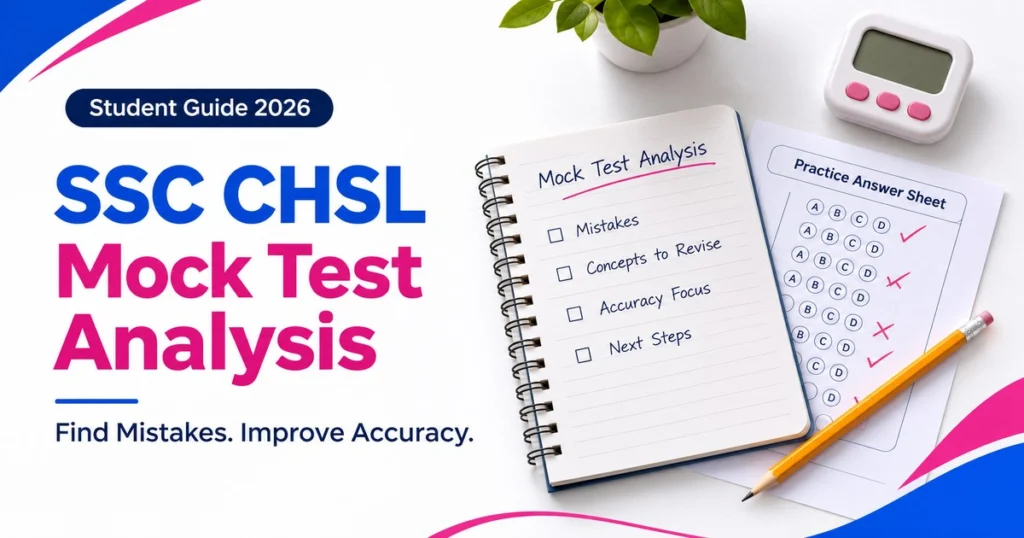
SSC CHSL mock test analysis helps you understand where your marks go: weak concepts, calculation errors, rushed guesses or poor time management. Did you misunderstand a percentage question, miss the word “not” in English, or spend too long on one reasoning problem? These need different solutions. Simply taking another test can repeat the same mistakes.
This SSC CHSL mock test analysis guide shows students how to calculate your Tier 1 score and accuracy, review attempted and unattempted questions, and build a focused revision plan. It includes a worked score example and a notebook format you can use today. The aim is to make your next practice session more useful, whether you study full time or fit preparation around college.
Start with the correct SSC CHSL exam pattern
The official 2026 notification specifies four Tier 1 subjects: English Language, General Intelligence, Quantitative Aptitude and General Awareness. Each has 25 questions carrying 50 marks. The standard test lasts 60 minutes, with a separate 15-minute subject timer. Eligible candidates covered by the notification’s scribe provisions receive the specified additional time.
For Tier 1, each correct answer earns two marks and each wrong answer loses 0.50 marks. Choose practice papers that follow these rules. Keep the current SSC CHSL syllabus and exam pattern beside your study plan so unrelated questions do not shape your preparation.
SSC CHSL mock test analysis: calculate score and accuracy
Your score measures marks earned after deductions. Accuracy measures how many attempted answers were correct. Both matter: a student can attempt more questions while losing marks through avoidable errors. Record unanswered questions too; they may reveal missing knowledge or poor time management.
Practice score = (correct answers × 2) − (wrong answers × 0.50). Accuracy = correct answers ÷ attempted questions × 100. The example below uses the same 100-question paper for two imaginary attempts. These are learning examples, not predicted cut-offs.
| Measure | Attempt A | Attempt B |
|---|---|---|
| Correct answers | 60 | 64 |
| Wrong answers | 20 | 12 |
| Unanswered | 20 | 24 |
| Accuracy | 75% | About 84.2% |
| Practice score | 110 | 122 |
Attempt B scores higher despite answering fewer questions. This does not mean you should always reduce attempts. It means you should examine whether extra attempts come from solved questions, informed decisions or rushed guesses. A mock score also should not be treated as an official normalized examination score.
Review your answer key: wrong, skipped and correct answers
Wrong answers: identify the exact cause
Compare your response with the mock answer key, then retry the question before reading its explanation. If you still cannot solve it, revise the concept. If you solve it easily, check your working for a calculation slip, misread instruction or hurried option selection. Write the specific cause instead of labelling everything a “silly mistake”.
For example, using the selling price instead of the cost price to calculate profit percentage is a concept error. Multiplying correctly but copying the wrong digit is an execution error. The first needs a short lesson and examples; the second needs a checking habit.
Unanswered questions: separate knowledge from timing
Attempt skipped questions without a timer. Questions you can now solve belong in your timing review. Questions you still cannot solve belong in your topic revision. This distinction prevents you from practising speed when the real problem is an unfamiliar formula.
Correct answers: check whether the method was reliable
Review solution explanations even for correct guesses: they can hide a weak topic. Mark correct answers that you guessed or solved using an uncertain method. Also revisit questions that took too long. A shorter, understood method can help, but memorising an unexplained shortcut often creates another error later.
Build an error notebook for weak-topic revision
You do not need to copy every question. Record the topic, mistake and next action in a few lines. Include the question reference so you can return to it. The notebook should help you revise recurring problems, rather than become another large book you never reopen.
| Topic | What went wrong? | Next action |
|---|---|---|
| Successive percentages | Added two changes directly | Revise the multiplier method; solve five examples |
| English error spotting | Missed subject–verb agreement | Review the rule and explain each correction |
| Number series | Spent too long testing patterns | Practise a timed set and review stopping decisions |
| General Awareness | Confused two similar facts | Create a short comparison note and recall it later |
Check official SSC examination updates separately from your practice records. A coaching platform’s score report can guide study, but it cannot confirm recruitment rules, vacancies or examination arrangements.
Improve time management with sectional tests
Because the standard 2026 format has separate subject timers, do not assume unused English time can be transferred to mathematics. Practise within each subject’s allocation. Notice whether you start slowly, get stuck midway or rush the final questions.
When reviewing a section, identify one question you should have left earlier and one manageable question you missed. That gives you a concrete pacing lesson. Avoid a rigid seconds-per-question rule: a short vocabulary item and a multi-step arithmetic question require different amounts of work.
Use older papers for question practice while applying current timing rules. Our guide to using previous-year question papers explains how to learn from them without simply memorising answers.
Plan topic-wise practice after each full-length mock test
Choose two recurring weaknesses after each full mock. Spend the next session revising those concepts, solving a small relevant set and checking whether the original mistakes return. For instance, repeated ratio errors need focused ratio practice before another complete paper.
If you have two hours, one workable session is 30 minutes of concept revision, 30 minutes of topic questions, 15 minutes of timed practice and 45 minutes of checking and reattempts. Adjust this example to your needs. The review time is part of preparation, not an optional extra.
Near your examination, check admit card updates and organise documents outside study time. Keeping these tasks in a short checklist helps prevent repeated checking from interrupting revision.
Judge progress across several comparable tests
Compare papers of similar difficulty and pattern. Track subject-wise performance in English, reasoning, mathematics and general awareness. Look for fewer repeated errors and more confident solutions across several attempts. One difficult paper does not erase progress. Equally, a high score on familiar questions does not prove every topic is ready.
Track your own improvement before comparing platform ranks. After the actual examination, use official answer keys and SSC result updates to follow the process. Practice scores are study evidence, not a selection guarantee.
Frequently asked questions
Q. How should I analyse an SSC CHSL mock test?
Ans. Review wrong, skipped and uncertain correct answers. Identify each cause, revise the relevant topic and reattempt the question independently.
Q. How do I calculate mock-test accuracy?
Ans. Divide correct answers by attempted questions and multiply by 100. Exclude unanswered questions from the attempted total.
Q. Should I take a full mock every day?
Ans. Only if you can review it properly. When basics are weak, focused topic practice between full tests may be more useful.
Q. What is SSC CHSL Tier 1 negative marking?
Ans. The 2026 notification specifies a deduction of 0.50 marks for each wrong answer. Keep this separate from Tier 2 rules.
Q. What should I do when my mock score stops improving?
Ans. Check recurring mistakes and subject-level accuracy. Change the next study session to address those gaps instead of only increasing test frequency.
Q. Can a mock score predict my final selection?
Ans. No. Paper difficulty, official scoring and recruitment stages affect the outcome. Use mocks to improve preparation rather than promise a result.
Official reference: SSC CHSL 2026 notification, Tier 1 examination scheme. Rules checked on 6 November 2026.